Most people don’t start noticing knee pain during some heroic moment. It creeps in quietly — a few weeks into a new running routine, or halfway through a gym program you were genuinely proud of sticking to. Everything’s going well — until your knee starts talking back. That nagging, hard-to-ignore ache has a name: Patellofemoral Pain Syndrome — and it’s one of the most common overuse injuries in active people.
It begins subtly. A little ache going downstairs. Some stiffness after sitting through a movie. Then one morning, the squats you’ve been nailing suddenly feel like someone’s pressing a hot coal against your kneecap. That’s what describes PFPS.
So, What Actually Is Patellofemoral Pain Syndrome?
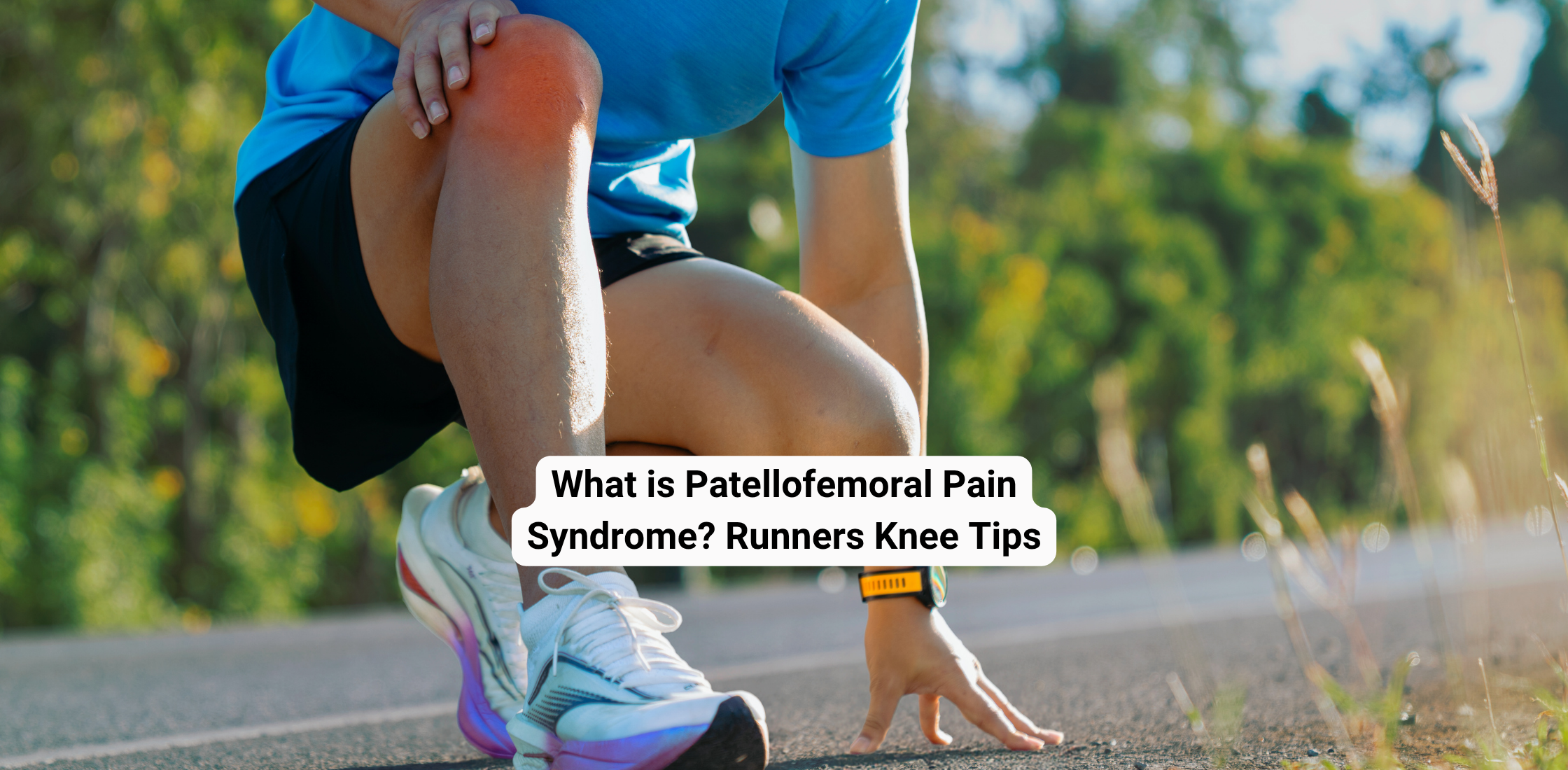
Patellofemoral Pain Syndrome (PFPS), often called “runner’s knee”, also means anterior knee pain. ‘Anterior knee pain’ is an umbrella term, but overall, it refers to pain around or behind your patella (knee cap). Not necessarily is it related to the damaging of the structures around the knee cap, but more due to the irritation of the structures. The sources of symptoms can include the most common one- patellofemoral joint, ITB, quads/patella tendon, fat pad, etc.
People with PFPS often report pain when using stairs particularly when going down, symptoms with squats, jogging, running, and pain after long periods of sitting. This condition affects many but more so the active population including athletes who participate in sports that involve repetitive knee bending ie. running, cycling, jumping. Females are also more likely to develop PFPS compared to males due to the anatomical differences. We often see younger kids or adolescents who sustain this condition, likely due to their more active lifestyle and their still developing body structures.
We’ve got a bit of an overview of this condition, but why do we develop this, and how can we solve this issue?
What Does Patellofemoral Pain Feel Like? Recognising the Signs
PFPS has a pretty recognisable fingerprint. You might notice:
The pain itself can feel different from person to person. Some describe it as a dull, persistent ache sitting right at the front of the knee. Others get something sharper — a more pointed sensation behind or around the kneecap that flares during movement and sometimes lingers long after they’ve stopped.
Stairs are a common flashpoint, and interestingly it’s usually coming down that hurts more than going up. The angle your knee works through on the descent loads the joint differently, and a lot of people don’t make that connection until someone points it out. Squats and lunges tend to aggravate things too — as does running, jumping, or anything that involves repeated knee bending under load.
One pattern I find particularly useful in clinic is what’s sometimes called the movie sign. You sit down feeling fine, stay in one position for an hour or two — at the cinema, on a long drive, at your desk — and by the time you stand up, your knee is stiff, achy, and needs a minute to get going again. If that resonates with you, it’s a fairly telling sign.
And some people mention a crunching or grinding sensation around the kneecap when they move. Honestly, that sounds worse than it usually is. It doesn’t necessarily mean anything serious is happening — but combined with the other symptoms, it’s absolutely worth having looked at properly
If three or more of those ring a bell, it’s worth getting a proper physio assessment rather than waiting to see if it passes on its own. Spoiler: it usually doesn’t, without addressing the underlying cause.
Recognise your symptoms? Book a PFPS assessment at ProCure Physio Blacktown — no referral needed.
Why Did This Happen? The 3 Real Causes of Runner’s Knee
This is where things get interesting — and where a lot of people get let down by generic advice online. PFPS isn’t caused by one thing. In my experience, it’s almost always a combination of factors that conspire together to tip the knee over the edge. Finding your combination is the whole game.
1. You Did Too Much, Too Soon
You Did Too Much, Too Soon
Honestly? This is the most common story I hear. Someone starts a new Couch-to-5K program. A gym-goer adds heavy leg days to their weekly routine. A weekend warrior doubles their training ahead of a half marathon. The motivation is real — but the body hasn’t caught up yet.
The patellofemoral joint is capable of handling enormous loads. During a deep squat, it can experience forces up to seven or eight times your body weight. That’s not a problem if you’ve built up to it gradually. It becomes a problem when you go from zero to that in a fortnight.
More than a 10% increase in weekly training volume is generally where things start to unravel. The tissues get irritated faster than they can recover, and the knee starts complaining.
2. Something Upstream Isn’t Pulling Its Weight
Here’s a clinical insight that surprises a lot of people: a lot of knee pain isn’t really about the knee.
When your hip muscles — particularly the gluteus medius and maximus — are underperforming, your knee has to compensate. It drifts inward (we call this dynamic valgus), the kneecap gets pulled laterally, and the pressure distribution across the joint goes haywire.
The VMO — the small teardrop-shaped muscle on the inner side of your thigh — also plays a significant role in keeping the kneecap tracking correctly. When it’s inhibited or weak, the kneecap tends to drift outward under load.
Tightness in the ITB and hip flexors can compound this by literally pulling the kneecap sideways. And sometimes the issue is more subtle — muscles firing in the wrong order, or not recruiting at all when they’re supposed to.
The evidence here is genuinely compelling: targeted hip strengthening programs have been shown to reduce PFPS pain by up to 50% within the first four to six weeks. Just treating the knee, in isolation, often misses the point entirely.
3. The Way You Move Might Be Loading Things Badly
Your lower limb works as one connected system. The foot affects the ankle, which affects the knee, which is influenced by the hip — all in real time, every step. When something’s off at one level, it ripples upward (or downward).
Take flat feet as an example. When the foot rolls inward more than it should with each step, it doesn’t just affect the foot — that inward movement travels up through the shin and thigh, and ends up compressing a part of the patellofemoral joint that really isn’t built for that kind of repeated pressure. It’s a surprisingly long chain reaction from something that starts at ground level.
Hip drop is another one that catches people off guard. It’s often so subtle that the person has no awareness of it at all — and yet when we film someone running and play it back in slow motion, there it is. A slight dip on one side with every stride, pulling the kneecap laterally thousands of times per session. Over weeks and months, that adds up to a significant amount of stress on the joint.
For runners in particular, overstriding or leaning too far from the trunk changes the whole dynamic through the knee cap. Small technique habits, repeated endlessly, leave a very clear mark
This is why we don’t just look at the knee in isolation at ProCure Physio. We assess how your whole lower limb is moving — because the cause is often nowhere near where the pain is.
How Physiotherapy Actually Fixes Patellofemoral Pain Syndrome
At ProCure Physio in Blacktown our physiotherapy management is not a one-size-fits-all approach, the interventions differ person to person depending on the needs and symptoms, especially as we mentioned earlier how PFPS is such a multifactorial issue. After identifying the main contributing factors to your condition, we tailor a treatment plan according to your needs. Some examples of treatment methods are as follows:
Targeted Strength and Rehab Exercises
Specific exercises targeting mobility, strengthening and/or motor control according to the deficits identified during the assessment will be prescribed. Also, taking into account the sensitivity of the tissue, different intensity and level of difficulty will be introduced according to the phase and causes of PFPS to address the impairments and symptoms.
Hands-On Treatment (When It Helps)
Some hands-on techniques such as soft tissue release, trigger point release may be applied to help with relieving symptoms, targeting tight muscle groups and improving muscle tension built up. Soft tissue release for tight quads, ITB, and hip muscles. Patellar mobilisation to encourage better kneecap tracking. Sometimes hip or ankle joint mobilisation if stiffness there is feeding into the problem at the knee.
Smarter Load Management — Not Complete Rest
This one matters a lot, and it’s something people often get wrong on their own. Complete rest doesn’t fix PFPS. It temporarily removes the pain, but the moment you reload the joint — which you will — it comes straight back.
What works is modifying your training intelligently. It is crucial to modify the activities and to reduce irritation on the structures. But it is important to avoid complete rest.
Education and Practical Self-Management
When dealing with conditions, not only bound to PFPS, it is important for the client to understand what is happening and what it is that they should do or avoid. Otherwise, without the knowledge, it is possible that the client will be doing all the aggravating activities unknowingly and making the condition worse. We want to ensure even not in the clinic, our clients are doing the right thing and progressing through their rehabilitation.
Gait Retraining for Runners
If you’re a runner, video gait analysis is often a game-changer. Watching your movement pattern in slow motion makes it easy to identify technique habits that are quietly loading the knee — things you’d never notice in real time. Adjustments to your cadence, trunk position, and hip control during running have been shown to reduce patellofemoral joint stress by up to 30%. That’s significant.
📞 Ready to stop guessing and start getting better? Book your assessment at ProCure Physio Blacktown.
Why Western Sydney Locals Choose ProCure Physio for Knee Pain?
Comprehensive Assessment: This forms the basis of our entire treatment plan. A thorough assessment is necessary to identify the root cause for your symptoms.
Personalised Treatment Plans: At Procure Physio, we do not offer one-size-fits-all plans. Every patient has a unique journey and so are their treatment plans. Every program is tailored to your needs, triggers, activity level and goals.
Movement-Based Recovery: Our movement-based recovery plan focuses on providing you guidance for long term maintenance by adopting a more sustainable and active lifestyle. At Procure Physio, it’s never a short term approach.
Convenient Access: Our location is easily accessible by public transport and we also have ample street parking right outside our clinic. A highly flexible schedule and extended work hours is an added advantage for consistent treatment.
How Long Until You’re Back to Full Fitness?
Honestly, recovery timelines depend a lot on your specific situation — how long it’s been going on, how much your strength and movement have been affected, and how consistently you can commit to rehab.
That said, mild cases usually turn a corner within four to six weeks. Moderate PFPS — the kind that’s been niggling for months — more commonly takes eight to twelve weeks to fully settle. For chronic or more complex presentations, three to six months of progressive work is realistic.
Starting sooner definitely pays off.
PFPS FAQs — Straight Answers to Common Questions
1.) What Does Patellofemoral Pain Feel Like? Recognising the Signs
It’s a knee condition characterised by pain around or behind the kneecap. The reason isn’t any structural damage, but from the joint being loaded poorly over time. It is commonly seen in active people like athletes.
2.) What does it actually feel like?
Some people describe it as a dul ache while others complain of a sharp pain at the front of the knee that shows up usually during or after an activity. Some people describe a crunching or clicking feeling when they stand up after spending a long time sitting. It can range from mildly annoying to genuinely limiting.
3.) What causes a runner’s knee?
Though there can be more than one contributing factor, the most common one is doing too much too quickly. It can be an outcome of weakness or poor control in the hip and thigh muscles, and biomechanical patterns in the foot, ankle, or hip that put extra strain on the kneecap.
4.) How do I fix patellofemoral pain syndrome?
Guided physiotherapy is the most effective treatment path, but it also involves lifestyle changes and retraining your habits.
5.) Can I keep exercising with PFPS?
Yes — and you probably should. Complete rest isn’t the answer.
6.) Is PFPS the same as runner’s knee?
Yes. “Runner’s knee” is just the everyday name for PFPS, they’re the same condition.
7.) Can a physio help with knee pain specifically when going downstairs?
Absolutely. Your Knee Pain Doesn’t Have to Be the Reason You Stop Moving
It starts with understanding your knee. Not a generic protocol. Not icing and hoping.
At ProCure Physio in Blacktown, we take the time to actually figure out what’s driving your pain — and then we build a recovery plan that fits around your life. Whether you’re a runner chasing a PB, a parent trying to keep up with the kids, or just someone who wants to get up the stairs without wincing — we can help.